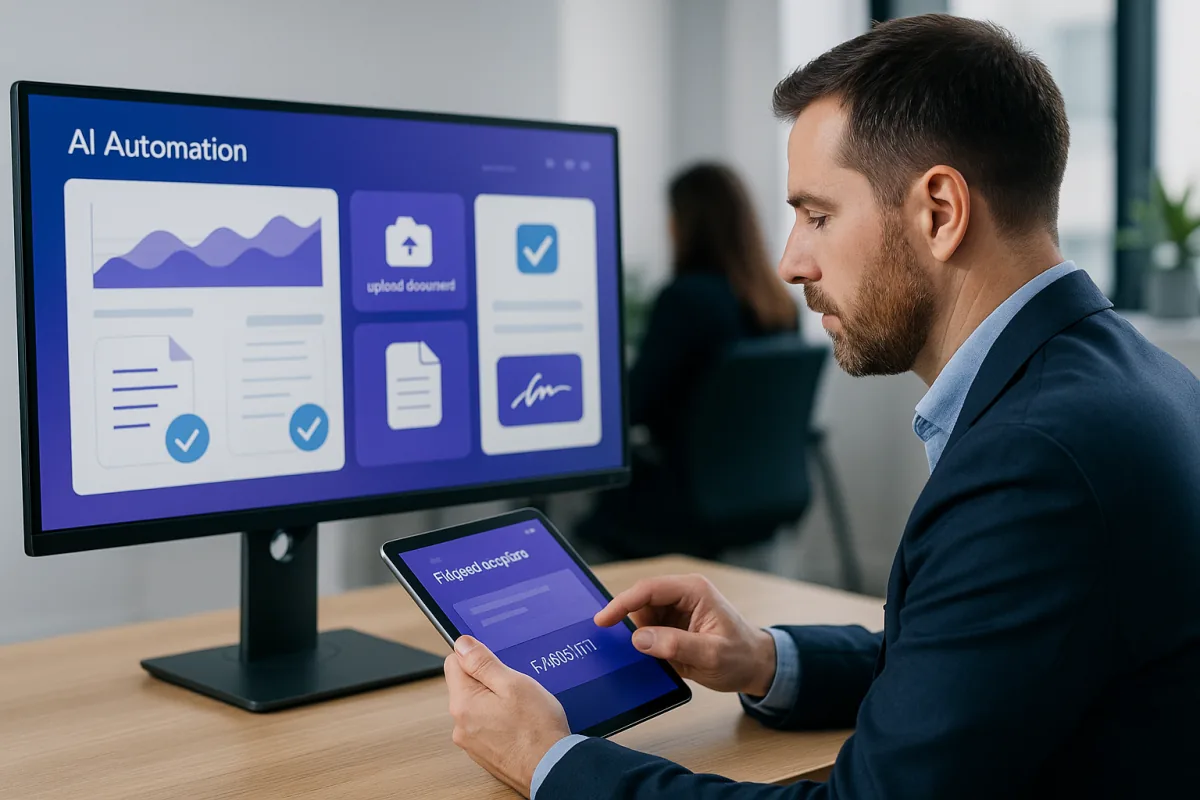
AI Automation for UK Accounting SMBs (2026 Guide)

Published on February 27, 2026
Business AI Agents logo
Dr. Shadi Ghaith Founder, Business AI Agents ·

AI automation lets UK accounting practices hand the repetitive work to software: email triage, AML document collection, invoice and receipt extraction, compliance deadline reminders, and routine client queries. Qualified staff keep the judgement work — advisory, review, sign-off — while the admin that used to swallow their week runs in the background, 24/7.

AI automation UK dashboard for accounting practice compliance deadlines

Part 1: Why UK accounting practices need automation now

AI automation is no longer optional for busy accounting practices serving UK SMBs. In 2026, AI automation for UK accounting SMBs is helping firms reduce admin time, improve HMRC compliance, and deliver faster client service—without adding headcount.

UK small and medium businesses remain the backbone of the economy. Official business population estimates put UK private-sector businesses at roughly 5.5 million, the overwhelming majority of them SMEs—so demand for accurate, timely accounting and compliance support is only rising.

But many practices still run core workflows that are difficult to scale:

  • Manual data entry from invoices and bank statements
  • Paper-heavy onboarding and AML checks
  • Overflowing inboxes and slow response times
  • Spreadsheet-based deadline tracking
  • Repetitive client queries consuming qualified time

Meanwhile, cost pressure is intensifying. SME sentiment surveys consistently rank rising costs and access to finance among UK SMEs' biggest concerns—pushing accountants to deliver faster, more proactive guidance.

As of 2026, AI adoption across UK SMEs has accelerated sharply: most firms now use AI in some form, and day-to-day use keeps climbing. The practical takeaway for accountants: the bar for speed, responsiveness and visibility has moved.

With UK SME employment and activity expected to keep growing, accounting practices should expect higher client demand—exactly when intelligent automation matters most.

Need Help with AI Solutions?

Get in touch with our team or try our AI assistant.

Accounting automation UK example: automated client onboarding and AML checklist

Part 2: How AI automation is already helping UK accounting practices win

AI automation for accountants in the UK is delivering measurable outcomes right now—especially when it's implemented around real workflows rather than generic tools.

1) Automating the administrative grind

A large portion of a week in practice is taken up by necessary but low-value work such as document chasing, invoice and receipt processing, bank statement handling, standard report generation, payment reminders and routine follow-ups.

AI process automation in the UK can handle much of this automatically, freeing qualified staff for advisory work clients will pay for.

2) Taming UK compliance complexity (HMRC + Companies House)

UK compliance is demanding across HMRC, Companies House filings and annual returns, VAT returns, PAYE, and Making Tax Digital (MTD).

AI-assisted workflows can extract data, validate completeness, flag anomalies, and draft submissions for review—turning multi-hour manual work into streamlined steps measured in minutes.

3) What firms typically achieve with automation

UK practices implementing accounting automation commonly report:

  • Client onboarding time cut sharply through automated document collection and verification
  • Invoice processing accelerated from days to hours via intelligent extraction
  • Deadline compliance improved through automated tracking and reminders
  • Capacity gains without new hires as AI handles routine correspondence and document admin

With a majority of UK SMBs planning to invest and hire through 2026, practices that are more proactive and responsive will be best positioned to win and retain strong clients.

Need Help with AI Solutions?

Get in touch with our team or try our AI assistant.

AI document processing for UK accountants extracting invoice and receipt data

Part 3: The real pain points—day-to-day inside a UK accounting firm

These are the operational issues that quietly cap growth, increase stress, and squeeze margins.

1) Email overload and slow triage

Many firms receive hundreds of emails weekly: tax questions, payroll queries, invoices, attachments, and HMRC/Companies House messages mixed together. Senior staff can lose a chunk of every morning just triaging.

Risk: urgent items (audit notifications, missed deadlines) get buried—leading to penalties, reputational damage and avoidable stress.

2) Client onboarding that drags for weeks

Onboarding can still take 1–3 weeks due to AML document collection, engagement letters, prior-year information requests, and HMRC registrations/verification.

3) Document collection and processing delays

Clients send information in every format—PDFs, photos, screenshots, or physical receipts. Figures commonly cited in practice-management studies put the share of billable time absorbed by manual processing and rekeying as high as a third, which for a small UK practice can mean hundreds of hours a year.

4) Deadline tracking across a complex compliance calendar

UK practices juggle a compliance calendar that never stops:

ObligationDeadline patternManual-tracking risk
Corporation Tax (CT600)12 months after year-endEvery client has a different year-end
Self Assessment (SA100)31 JanuaryEvery client's deadline lands at once
VAT, PAYE/Payroll, MTDRecurring through the yearCycles slip in spreadsheet tracking
Companies House annual returnsClient-specific filing datesOne missed date triggers penalties

Spreadsheet-based tracking creates obvious risk: one missed deadline can trigger surcharges and damage client trust.

5) Repetitive client queries consuming qualified time

Common repeat questions include "When is my VAT due?", "What expenses can I claim?", "How do I set up payroll?", and "What's the threshold for X credit?". Clients deserve quick answers, but not every query needs a qualified accountant.

6) Payroll processing pressure (high-volume, high-risk)

Payroll is relentless: hours collection, tax/NI accuracy, PAYE submissions, payslips. Errors are costly and immediate—especially as UK SME employment grows.

Need Help with AI Solutions?

Get in touch with our team or try our AI assistant.

HMRC compliance automation UK: CT600 SA100 VAT PAYE reminder workflow

Part 4: Business AI Agents AI solutions for UK accounting practices

At Business AI Agents, we build custom AI agents for UK businesses—including accounting firms—designed to remove operational bottlenecks, reduce risk, and create capacity for advisory work.

1) Smart email management for accountants

An AI email workflow — our Email Manager — that supports your team 24/7:

  • New client enquiries: identified, acknowledged, routed with a summary
  • Document submissions: attachments detected, filed to the correct client folder, logged for processing
  • Compliance alerts: HMRC/Companies House messages flagged as high priority with calendar integration
  • Routine queries: answered instantly using your approved knowledge base
  • Urgent issues: sentiment/urgency detection escalates distressed messages immediately

What that looks like in practice: for a multi-partner firm, average email response time falls from half a day to minutes, and each accountant gets a meaningful slice of the day back for billable work.

2) Intelligent client onboarding automation (AML + engagement letters)

Turn onboarding into a smooth, trackable workflow:

  • Automated welcome sequence with secure document upload
  • AML document collection with completeness checks and follow-ups
  • Engagement letters generated by service selection, sent for eSignature, filed automatically
  • HMRC details verification
  • Prior-year information requests and polite chasers
  • Integration into practice tools (Sage, Xero, QuickBooks, etc.)

What that looks like in practice: onboarding that used to drag for weeks completes in days, with hours of manual admin per new client removed.

3) Automated document processing and data extraction

Reduce or remove manual entry with multi-format support (PDFs, photos, scans, email attachments), intelligent extraction accurate enough that only exceptions need human review, auto-categorisation to chart of accounts, and exception flagging—integrating to Xero, QuickBooks, Sage, or your preferred system.

What that looks like in practice: a sole practitioner with a full SMB client list reclaims the better part of a working day each week previously spent on manual data entry.

4) Compliance deadline tracking + automated reminders

A compliance-first automation layer for UK obligations:

  • Automated compliance calendar per client (CT600, SA100, VAT, PAYE, Companies House, MTD)
  • Client reminders at 4, 2 and 1 week before document deadlines
  • Internal alerts with ownership assignment
  • Monitoring of HMRC correspondence linked to the correct client obligation
  • Real-time dashboard across the portfolio

What that looks like in practice: late-filing penalties stop being a line item, because nothing waits on a spreadsheet being checked.

5) 24/7 AI client query system (web + WhatsApp + email)

Give clients fast answers without flooding your team—using a knowledge base aligned to your firm's guidance and UK compliance realities, instant answers for routine questions, smart escalation for judgement-based or sensitive queries, and analytics on recurring questions to improve client comms.

Integrations: works with the tools UK practices already use

Business AI Agents AI agents integrate with practice management (CCH, Wolters Kluwer, Sage Practice), accounting software (Xero, QuickBooks, Sage 50), comms (Outlook, Gmail, Teams, WhatsApp Business), docs (SharePoint, Google Drive, Dropbox), and eSignature (DocuSign, Adobe Sign).

Ready to automate your accounting practice in the UK?

If your firm serves UK SMBs and you're feeling the strain of admin, inbox overload, document chasing, or deadline risk, AI automation is one of the most valuable upgrades you can make in 2026.

Business AI Agents specialises in custom AI agents for UK accounting firms and professional services. Our founder, Dr. Shadi Ghaith, brings 27+ years' software engineering experience (including 15 years at IBM Ireland) and a PhD in Computer Science from UCD—focused on practical, secure, measurable automation.

Talk to us about a custom AI agent built around your workflows:

Business AI Agents — AI automation UK, built for real practice operations.

Frequently asked questions

What accounting tasks can AI automate safely?

Common safe wins include email triage, document collection, invoice/receipt extraction, deadline reminders, and answering routine queries from an approved knowledge base. Judgement work — advisory, review, sign-off — stays with qualified staff.

Will AI replace accountants?

No. In practice, AI reduces repetitive admin and improves turnaround time. The competitive advantage comes from reallocating time to advisory services, not replacing qualified expertise.

Is AI automation compliant with UK data protection requirements?

Yes—when implemented properly. The key is selecting secure infrastructure, applying least-privilege access, maintaining audit logs, and using appropriate data retention policies under UK GDPR.

Which HMRC deadlines can automation track?

All the recurring ones: Corporation Tax (CT600), Self Assessment (SA100), VAT returns, PAYE, Companies House filings and Making Tax Digital obligations—with client reminders at set intervals before each deadline and internal alerts with ownership assigned.

Does AI automation work with existing accounting software?

Yes. Well-built agents integrate with practice management tools (CCH, Sage Practice), accounting software (Xero, QuickBooks, Sage 50), comms (Outlook, Gmail, Teams, WhatsApp Business), document storage and eSignature platforms.