

How to Recall an Email in Gmail (and What to Do When You Can't)

Published on 31 July 2026
Business AI Agents logo
Dr. Shadi Ghaith Founder, Business AI Agents ·

Gmail has no true recall. What it has is Undo Send: for 5, 10, 20 or 30 seconds after you click send, Gmail quietly holds the message and shows an Undo button. Click it and the email never leaves. Miss it and the message is delivered, permanently, to a server you do not control.

Estate agent at a laptop watching a sent email fly towards the wrong recipient as a timer counts down
The two seconds between sending and realising. This is the whole market for Undo Send.

How to recall an email in Gmail, step by step

Thursday, 5.40pm, a four-branch estate agency in Manchester. A negotiator is clearing the day's emails and sends a vendor's full valuation report — asking price, the reason they're moving, the bit about the divorce — to Sarah. Autocomplete supplied the surname. It was the wrong Sarah: an applicant who viewed the property in March and never came back.

She sees it. The bottom of the screen says Message sent, and next to it, for a moment, Undo. Then it's gone. So is the countdown, and so is any version of the evening she had planned.

Undo Send, in the seconds you have

Do this the moment you realise, and nothing else first:

  1. On a computer, look at the bottom left. Gmail shows a small dark box reading "Message sent" with Undo beside it. Click Undo. The message reopens as a draft and was never delivered.
  2. On Android or iPhone, the same bar appears along the bottom of the screen with an Undo option. Tap it. It vanishes faster than you'd like, which is why it's worth deliberately practising once on an email to yourself.
  3. If the box has gone, it is gone. There is no menu item, no keyboard shortcut and no setting that brings it back. Skip to the next section, which is about the twenty minutes that follow.

Set the cancellation period to 30 seconds now

Gmail ships with the window set to 5 seconds, which is roughly the length of time it takes to think "wait". You can extend it to 30, and there is no downside beyond your emails arriving half a minute later.

On desktop: the gear icon → See all settingsGeneralUndo send, and choose a send cancellation period of 5, 10, 20 or 30 seconds — then scroll down and click Save Changes, which is the step people forget. The setting is per account, not per device: change it once on a laptop and your phone follows.

Thirty seconds is the ceiling. Google has offered the same four options for years and there is no enterprise tier, admin console or paid plan that raises it.

Why this isn't really a recall

Undo Send doesn't reach into anyone's inbox and take an email back. It postpones the send. During your 5 to 30 seconds the message is sitting on Google's own servers with a timer on it, and clicking Undo simply cancels the delivery before it starts. The recipient never gets anything — no email, no notification, no trace.

The instant that timer expires, Gmail hands the message to the recipient's mail provider, and that copy belongs to them. This is how email has worked since long before Gmail existed: it is a delivery system, not a shared document. Deleting the message from your Sent folder deletes your copy and does nothing whatsoever to theirs.

Which is why the honest answer to "can you recall email from Gmail" is: only before it was sent. Everything else marketed as recall is one of the four things in this table, and it pays to know which one you're being sold.

What it's calledWhat it actually doesWorks whenGets the email back?
Gmail Undo SendDelays delivery by 5-30 seconds so you can cancelAlways, inside the windowYes — because it never went
Outlook message recallAsks the recipient's mailbox to delete the messageSame Microsoft 365 organisation, message unreadSometimes, and never outside your org
Delete from SentRemoves your own copyAlwaysNo
Gmail confidential modeSets an expiry and blocks forwarding, copying and printingOnly if switched on before sendingRevokes access, but cannot stop a screenshot

Confidential mode is the one worth knowing about in advance, because it's the only entry that helps after delivery — and only for messages you had the foresight to send that way. For the valuation report that went to the wrong Sarah, nobody had that foresight. Nobody ever does.
Need Help with AI Solutions?

Get in touch with our team or try our AI assistant.

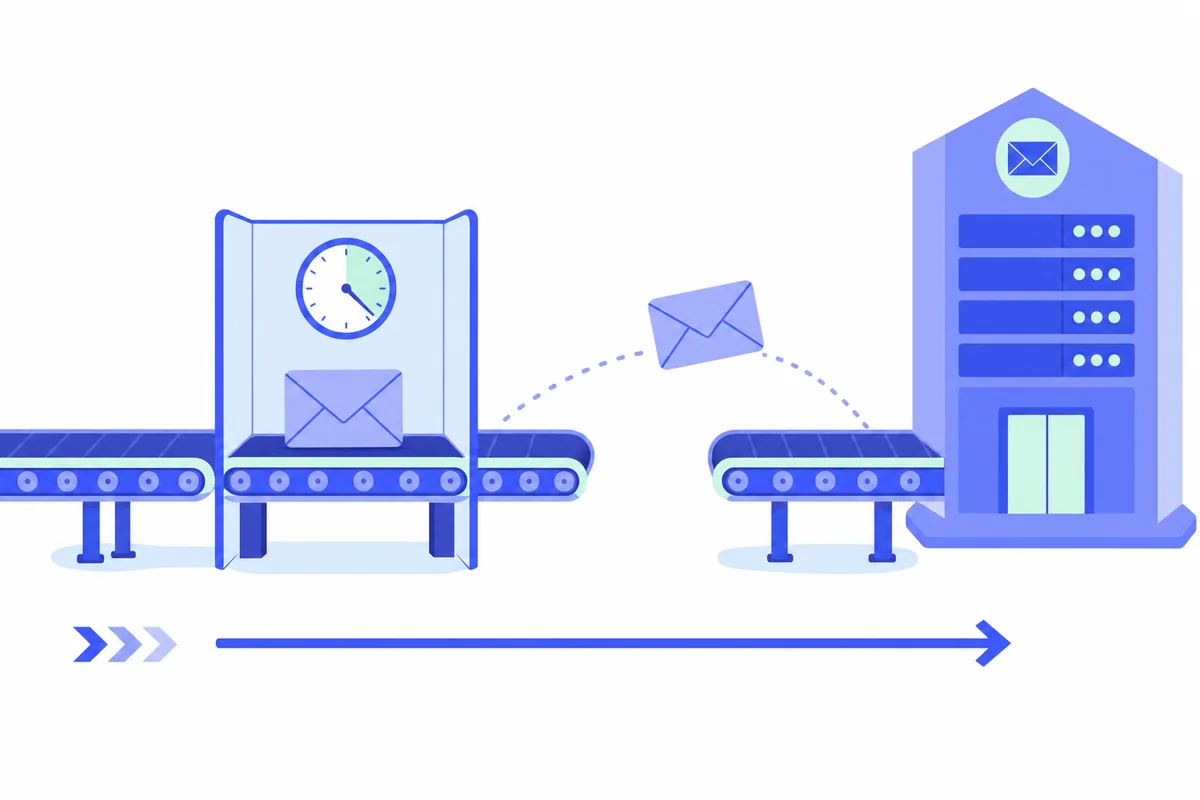
Diagram showing an email held briefly in a waiting bay then handed one way to a distant mail server
Held for thirty seconds, then handed over. There is no arrow pointing back.

What to do after the window closes — and how to stop needing it

Once the message is delivered you are no longer managing an email. You are managing a disclosure, and in the UK that has a clock on it.

The Information Commissioner's Office publishes every personal data breach reported to it, updated quarterly, and the pattern barely moves. Most reported breaches are non-cyber — people, not hackers — and "personal data emailed to the incorrect recipient" has sat at or near the top of that list for years, ahead of lost devices, wrong postal addresses and everything else. Article 33 gives an organisation 72 hours from discovery to report a notifiable one. Nobody at the ICO is going to be surprised by your incident. They will only ask what you did next.

The first thirty minutes

WhenDo thisWhy it matters
ImmediatelyEmail the wrong recipient, plainly, and ask them to delete it unreadMost people do. It also creates a written record that you asked
Within minutesWrite down what was disclosed, to whom, and at what timeYou will need this exact list later, and memory degrades fast
Same hourTell whoever handles data protection in your businessThe 72-hour clock starts when the organisation becomes aware, not when it decides to act
Same dayDecide whether the risk is high enough to report to the ICO, and tell the affected client either wayOnly breaches likely to risk people's rights need reporting — but that call has to be made and recorded

None of that is dramatic: a bad half hour, a worse phone call to the vendor, and an entry in a log. It is worth writing down in advance, because everyone handles it better with a list than with adrenaline.

How can I resend an email in Gmail once it's fixed?

Usually the correction is the same email, sent properly. Gmail has no resend button, so you have two options. Open the message in Sent and click Forward: the attachments come with it, but Gmail adds a "Fwd:" prefix that cannot be removed, which looks like what it is. Or copy the body into a fresh message and reattach the files — thirty seconds longer, and the recipient sees a clean email rather than evidence of the first attempt.

The prevention that actually works

The standard advice is to type the recipients last and proofread before sending. It's good advice and it fails for exactly the reason the negotiator's evening failed: at 5.40pm on the twelfth email of the hour, nobody is proofreading. They're clearing.

A better model is to put something between "send" and "sent" that doesn't get tired. Three things can occupy that gap, and they catch different mistakes.

The mistakeUndo Send catches itSchedule send catches itAn AI pre-send check catches it
Wrong recipient from autocompleteOnly if you notice in 30 secondsOnly if you re-read the queueYes — the name doesn't match the thread or the record
Missing attachmentSame 30 secondsYes, on reviewYes — the body promises a file that isn't there
Everyone in CC instead of BCCRarely — it looks fine at a glanceRarelyYes — unrelated recipients on one message is a rule
Sensitive detail to an outside addressNoNoYes — bank details or health data leaving the domain is a rule
Reply sent while angryOccasionallyYes — time is the pointPartly — it can flag the tone, not the impulse

Schedule send is free and underrated: composing with a five-minute delay turns every email into a draft you can still catch, and Gmail's Scheduled folder is a genuine safety net. Use it for anything that leaves the business.

The AI column is the one the how-to guides skip entirely, and it is the only one that works while you're not paying attention. Mechanically it is unglamorous. A model reads the draft at the moment you click send, before the message is handed on, and applies a handful of written rules: does this recipient appear anywhere in the thread or the CRM record; does the body mention an attachment that isn't attached; are there unrelated external addresses in the same To field; does the text contain the kinds of details that shouldn't leave the domain unencrypted. If everything passes, the email goes and you never know it happened. If something fails, you get one question before it leaves — this is going to an applicant, not the vendor, is that right?

That is the whole idea. Not a smarter recall, because there is no such thing. A check that runs on the ninety-nine emails where you were right, so it's there on the hundredth where you weren't.

Need Help with AI Solutions?

Get in touch with our team or try our AI assistant.

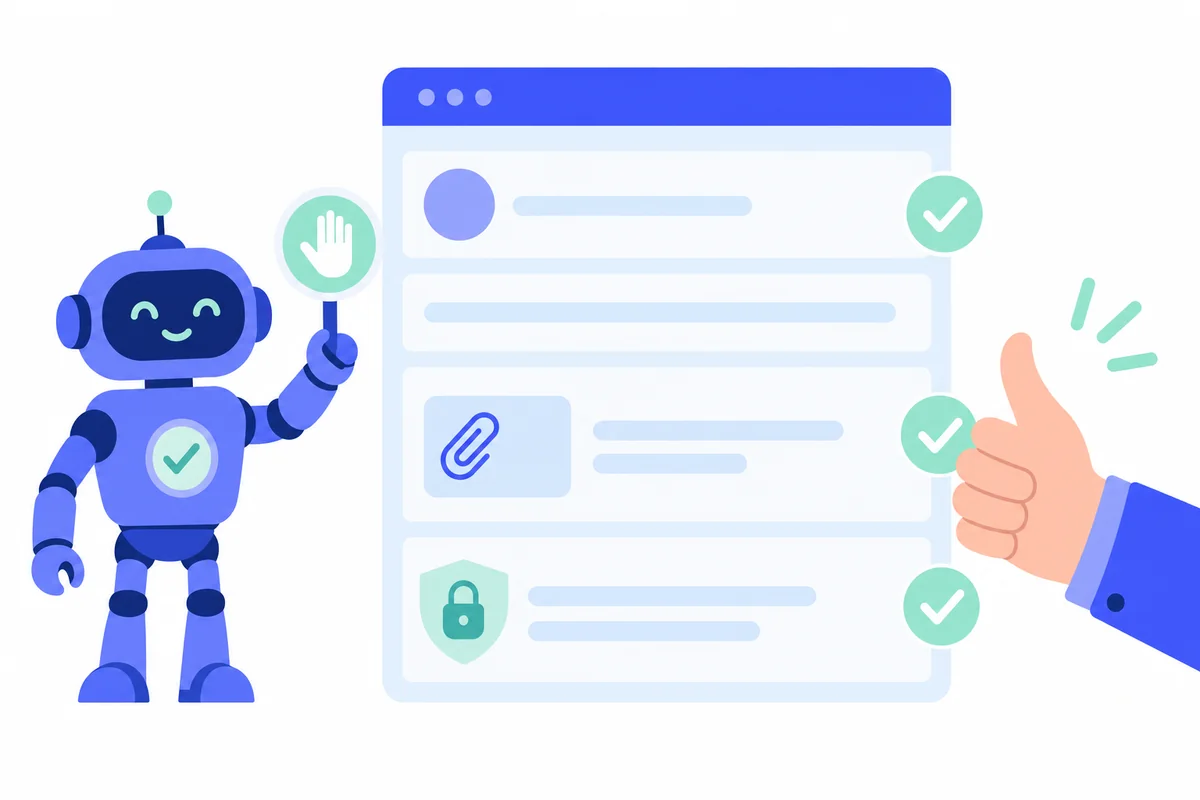
AI assistant holding up a stop sign beside an email draft while checks on recipient, attachment and content pass
The check that runs on the ninety-nine emails where you were right.

How we set up an AI Email Manager to catch the wrong send

At Business AI Agents we build inbox automation for UK small and medium businesses, so the pre-send check isn't a thought experiment — it's a feature of our Email Manager, and it runs on our own inbox first. Every enquiry that arrives through this website, the chat agent on this page included, passes through it before it reaches me. I read them all, personally, and reply within 24 to 48 hours.

What it looks like for an estate agency

  • Recipient verification against the record. The agent knows which contacts belong to which property and which side of the deal they're on. An email carrying a vendor's valuation to an address filed under applicants is stopped and queried before it sends, which is precisely the mistake autocomplete makes on a Thursday evening.
  • Attachment and content rules. Body mentions a floorplan with nothing attached, or a mortgage-in-principle heading to an outside domain: both raise a flag. The rules are written in plain English by the agency, not by us, because they know what should never leave.
  • Drafts, not sends, for the first fortnight. The agent sorts, routes and drafts; a person approves. When the edits stop, we widen what it may do alone. Starting at full autonomy is how you learn about the edge cases from a client rather than from a log.
  • The rest of the pile. Sorting viewing requests, chasing the follow-ups nobody has time for and clearing the overnight backlog is the same system doing its ordinary job — we covered the numbers behind that in our guide to AI inbox automation for UK businesses, and the wider picture in AI automation for UK estate agents.
  • The calls and the viewings. The enquiries that come in by phone at 5.40pm are the same problem in another medium, which is what our AI Receptionist answers and books, while Leads Outreach qualifies the applicants worth ringing back.

The honest limits

Two things we'd rather say here than after an invoice. First, a pre-send check adds friction, and friction is the point — if you tune it to query everything, people will click through it blind within a week, so the rules have to be few and sharp. We would rather stop three emails a month and be right than stop thirty and be ignored.

Second, no amount of checking retrieves a message that has already gone. The AI moves the save point from "after delivery", where nothing works, to "before delivery", where everything does. Anyone selling you recall after the fact is selling you a delete request that a stranger's mail server is free to ignore.

And because the agent reads your email to do any of this, it matters where that reading happens. Under UK GDPR you remain the controller: know which provider processes the text, keep training on your data switched off, give the agent the narrowest access that does the job, and log what it did. Our privacy policy is the canonical wording for how we handle ours.

Need Help with AI Solutions?

Get in touch with our team or try our AI assistant.

Recalling Gmail emails: your questions answered

Frequently asked questions

How long do you have to recall an email in Gmail?

Between 5 and 30 seconds, depending on your setting. Gmail defaults to 5 seconds and lets you extend the send cancellation period to 10, 20 or 30 seconds in Settings. Thirty seconds is the maximum Google offers, and there is no way to go beyond it.

Can you recall an email from Gmail after it has been read?

No. Once the Undo window closes the message has been delivered to the recipient's mail server, which is a system you do not control. Read or unread makes no difference in Gmail. Deleting it from your own Sent folder removes only your copy.

Can you unsend an email after an hour?

Not in Gmail. Add-ons that claim hour-long recall either delay the send behind the scenes or replace the content of a link rather than the email itself. If an hour has passed, treat it as delivered and handle it as a correction, not a recall.

How do I recall an email in Gmail on my phone?

Tap Undo in the black bar that appears at the bottom of the screen straight after sending. It disappears quickly, so it is worth practising once. The cancellation period itself can only be changed in Gmail's desktop settings, not in the mobile app.

How can I resend an email in Gmail?

Gmail has no resend button. Open the message in Sent and click Forward, which carries the attachments across but adds a "Fwd:" prefix you cannot remove. For a clean resend, copy the body into a new message and reattach the files yourself.

Can a Google Workspace admin delete an email that has already been sent?

Only inside your own domain. An administrator can search and remove a message from a colleague's mailbox using the admin tools. Once the message has reached an outside organisation, no admin function, and no Vault retention rule, will bring it back.

Do I have to report a misdirected email to the ICO?

Only if the breach is likely to risk people's rights and freedoms, and then within 72 hours of becoming aware of it. A colleague's lunch order is not reportable. A client's bank details, health information or home address sent to a stranger usually is.

The practical close

Two things to do before you close this tab. Set your cancellation period to 30 seconds — it takes eleven seconds and buys you six times the thinking room. Then send yourself one email and deliberately click Undo, so your hand knows where the button is before the evening it matters.

Back to Thursday, 5.40pm. Same negotiator, same twelfth email of the hour, same wrong Sarah offered by autocomplete. This time a question appears before anything leaves: this address is filed as an applicant, not the vendor — send anyway? She looks. She doesn't. The valuation report goes to the right person, the evening stays as planned, and nobody writes anything in a log.

If your inbox is one distracted click away from that half hour, talk to us and we'll tell you honestly whether you need a build or just a better setting. Or ask the chat agent on this page — it runs on the same system that checks our own email before it goes out.