
Local LLM for Estate Agents: A Model in the Branch, Managed
The model that writes a warm listing is not always the model that reads a tenancy agreement accurately or checks an AML file against a list. A branch needs both, so the choice has to be made on the branch’s own paperwork.
£500 per month for the software and the hardware rental. You rent the machine — you don’t buy it.
A local LLM for estate agents is a language model running on a machine in the branch rather than a provider’s cloud, chosen for listing copy, tenancy and sales files, AML records and landlord correspondence. Portals and CRM stay as they are; the model is installed, kept current and supported by us, and nothing leaves the office.
Find out which model suits the job
A short call with the branch manager or director. If your paperwork does not justify a machine, we will say so.
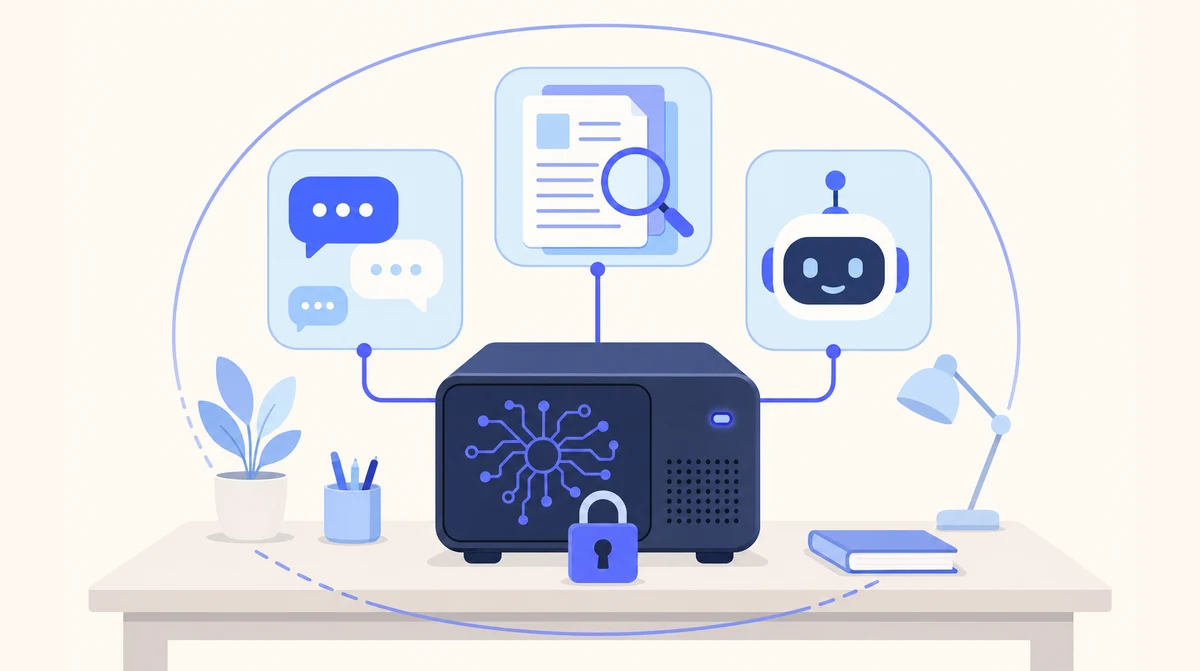
One machine in the branch, an open-weight model chosen for property paperwork, and the chat and document tools around it. Files never leave the office.
Cloud Agents for Enquiries, Local AI for the Paperwork
Viewing requests and valuation enquiries suit a hosted agent; tenancy files, AML records and vendor correspondence suit a machine in the branch. Most agencies run both.
- ☁ Cloud-based AI Receptionist
- ☁ Cloud-based Email Manager
- ☁ Cloud-based Leads Outreach
- 🏢 On-premise Local AI
Do It Yourself, or Have It Done
Running a local LLM is not hard for an afternoon. Running one for estate agents, every working day, with backups and someone to ring, is a different job.
| DIY on a spare machine | Cloud LLM subscription | Managed local LLM in the branch (ours) | |
|---|---|---|---|
| Where prompts and files go | Your machine | The provider’s servers | Your machine |
| Choosing local LLM models | Trial and error, evenings | No choice | Tested against your documents by us |
| Hardware | Whatever is spare | None | Specified for the team and rented to you |
| Reads your document library | If you build it | Only what is pasted in | Document spaces with citations |
| Model upgrades and updates | You, when you remember | Automatic | Us, as part of support |
| When it breaks | You | Their status page | Restored from backup by us |
Two Jobs, One Model, Chosen on the Branch’s Paperwork
A branch wants a local LLM for two quite different jobs. The first is writing: viewing notes in, a listing draft out in the branch’s house style, with the material-information items National Trading Standards expects checked against the file. The second is reading: what does this tenancy say about subletting, summarise this sales file before the call, which documents is this AML customer due-diligence file missing against our checklist. Open-weight models are not equally good at both, and the branch needs one machine that does both well.
So the choice is made on the branch’s own paperwork. We shortlist candidates on a call with the branch manager or director about sales, lettings or both, specify a machine that runs the largest of them well for the team, install it in the back office, import a sample of listings, tenancy files and templates into document spaces, and test the shortlist on them before settling. The model that reads a tenancy agreement faithfully and cites the clause usually wins, because a warm listing is easier to fix by hand than a wrong answer about a break clause.
Around the model sit the tools negotiators touch: a private chat assistant for drafts, document spaces that answer questions across files with the clause cited, and a custom assistant that checks an AML file against the branch’s list — without verifying anyone or making the risk assessment, which a person does. Rightmove, Zoopla, OnTheMarket and the CRM are not connected; drafts go back by a person pasting them.
The model stays ours to look after: updates, upgrades made with you, backups agreed before go-live, support from the people who installed it. Nothing in the files — tenants’ references, landlords’ details, identity documents — leaves the building to get any of it done.
The Model Is the Engine. This Is the Car.
A bare model is a demo. Estate agents need the machine, the tools around the model, the sign-in and someone to maintain it.
A model matched to the work
An open-weight local LLM chosen and tested against your own documents, on a machine specified to run it well for your team size.
Document spaces around it
The model on its own answers from what you paste in. Spaces let it search, summarise and compare across hundreds of your files, citing the page each answer came from.
Chat and assistants on top
A private chat assistant for the team and custom assistants for the recurring jobs, all running on the same machine as the model.
| Document | What the branch asks for | What stays where |
|---|---|---|
| Viewing notes and photos | A listing draft in house style; material-information gaps listed | On the machine, in the branch |
| Tenancy agreements and renewals | What the tenancy says; a summary before renewal | On the machine, in the branch |
| Sales files and vendor correspondence | A summary; the answer to a buyer’s question, cited | On the machine, in the branch |
| AML customer due-diligence files | Which documents are present and missing, against your checklist | On the machine, in the branch |
| Landlord instructions and management agreements | What was agreed; the clause on repairs | On the machine, in the branch |
| CRM and portal listings | Not connected — a person pastes drafts back | Your existing systems |
From a Branch Manager’s Call to a Model in the Back Office
Weeks, not months. Multi-branch agencies start with one branch and one job and widen from there.
A call with the branch or director
Sales, lettings or both, how many staff, which paperwork goes first. We specify the machine from that.
Install and import
The machine goes on the branch network. Sign-in connects to your Microsoft 365 or Google Workspace. Files, templates and correspondence for the first team are imported into spaces.
Train the team, then support
We train negotiators and managers on what it does and what it is not for. Updates, model upgrades and support follow, from the people who installed it.
Where Local AI Is the Wrong Answer
We would rather lose the enquiry than the trust. Three things we tell every prospect before they sign anything.
It is not a frontier model
The largest cloud models are still ahead of any local LLM on hard, novel reasoning. If your work needs that, a local model is the wrong tool and we will say so. For summarising, drafting and answering questions about your own documents, most offices are happy with it.
It is slower than the big cloud models
Open-weight models on a single machine are capable for summarising, drafting and answering questions about your own documents. For frontier reasoning on hard, novel problems, the largest cloud models are still ahead. That is the trade.
It is a weeks-long install, not a sign-up
A cloud agent is live in days. Local AI needs the machine specified, delivered, installed on your network and your documents imported. Weeks, not months — but not tomorrow.
We Run Our Own
Chosen against your files
Model selection is tested on a sample of your own documents, not a public leaderboard.
Sized with the model
The machine and the model are specified together. A model the hardware cannot run well is the commonest DIY mistake.
Upgrades made on purpose
Model upgrades are part of support, so someone is deciding when the answers your team relies on are allowed to change.
UK data protection built in
No third-party AI processor and no restricted transfer for the AI step. UK GDPR, the Data Protection Act 2018 and the ICO as regulator, with a data processing agreement for the support access you grant us.
Which Page Answers Your Agency’s Question
| If your question is… | The short answer | Read more |
|---|---|---|
| How is the model chosen in general? | Tested against your documents, not a leaderboard | Local LLM |
| We want the Local AI overview for estate agents | The head page for agencies | Local AI for estate agents |
| What exactly is installed in the branch? | One machine in the back office, supported | On-Premises AI for estate agents |
| Our compliance officer needs the data flow | No processor, no transfer, for the AI step | GDPR Compliant AI for estate agents |
| Viewing requests go unanswered | A hosted agent, live in days | AI Receptionist |
| We are in Manchester | Managed local LLMs across Greater Manchester | Local LLM Manchester |
| Why on-premises at all? | The case for Local AI, in full | Local AI product page |
Local LLMs for Estate and Letting Agents: Common Questions
What is a local LLM?
A large language model — the kind of model behind chat assistants — running on hardware you control rather than accessed through a provider’s service. Your prompts, uploaded documents and chat history stay on that machine in the branch.
Which local LLM models do you install?
It depends on the job. Drafting and summarising, answering questions across a document library, and structured extraction each favour different open-weight models, and the machine has to fit the model. We shortlist and test candidates against a sample of your own documents during setup.
Can one local LLM write listings and read tenancy files?
Yes, if it is chosen for both. We test the shortlist on a sample of your listings, tenancy files and templates before settling, and the model that reads agreements faithfully and cites the clause usually wins — a listing is easier to fix by hand than a wrong answer about a break clause.
Does the model see the portals or the CRM?
No. Rightmove, Zoopla, OnTheMarket and your CRM stay exactly as they are. Documents are exported to the machine; listing drafts and summaries go back by a person pasting them. The model only ever sees what is on the machine in the branch.
Does it connect to our CRM or the portals?
No. Rightmove, Zoopla, OnTheMarket and your CRM stay exactly as they are. Documents and correspondence are exported into spaces on the machine; what the assistant drafts is pasted back by a person.
Can it help with AML files?
As an assistant, yes. A custom assistant can go through a customer due-diligence file and list which documents are present and which are absent against your own checklist. It does not verify identity and it does not make the risk assessment; a person does.
How much does Local AI cost?
£500 per month for the software and the hardware rental. The dedicated machine is rented to your business, not sold: you never buy the hardware. It is installed in your building and runs the private chat, document spaces and assistants. Local AI is for business customers only.
Test the Model on Your Own Files
Tell us whether you are sales, lettings or both, and which paperwork takes longest. One short call to shortlist the model and size the machine.
Prefer email? sghaith@businessaiagents.co.uk